ECR Cost Insights
Every container image you push to Amazon ECR bills per GB-month until someone deletes it — and CI/CD pipelines push new images daily while almost nothing deletes old ones. CloudPouch ECR Cost Insights show which repositories have accumulated deletable images and what removing them saves.
What CloudPouch checks
Section titled “What CloudPouch checks”- Outdated container images superseded by newer pushes.
- Unused container images that are cleanup candidates.
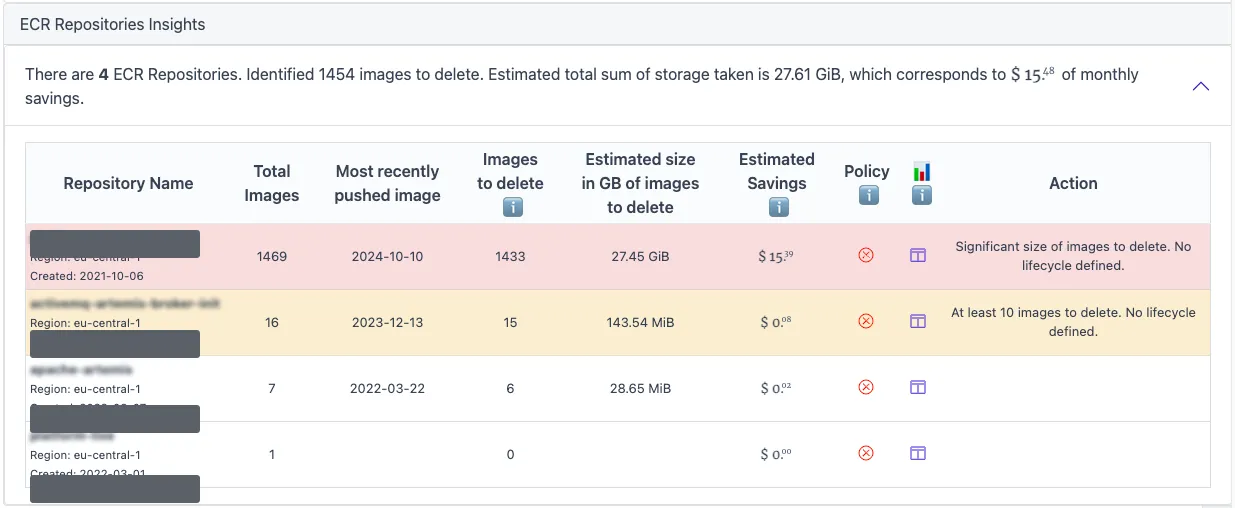
- Repository storage cleanup opportunities, per repository: image counts, how many images can go, the estimated storage they occupy, the estimated saving, and policy status.
Why this costs money
Section titled “Why this costs money”ECR charges per GB-month of stored image data, with no expiry and no lifecycle applied by default. The growth pattern is mechanical: a pipeline that pushes an image on every merge adds gigabytes of new layers a month per service (layer deduplication softens this, but multi-stage builds and base-image updates keep real growth high). Multiply by dozens of services and a few years of history, and repositories quietly hold thousands of images of which only a handful — the currently deployed tag and a rollback candidate or two — matter. Current storage rates are on the Amazon ECR pricing page.
Unlike most AWS waste, this one has a permanent fix: an ECR lifecycle policy that keeps the last N images per repository and expires the rest. CloudPouch’s policy status column shows which repositories are still relying on manual cleanup.
When to use it
Section titled “When to use it”Run this insight when ECR storage costs grow steadily release after release, when repositories predate any lifecycle-policy standard in your organization, or as a one-time audit before rolling lifecycle policies out fleet-wide.
How to act on findings
Section titled “How to act on findings”Delete confidently but not blindly: keep the images your running workloads reference (including anything a rollback might target), and check for tags referenced by infrastructure-as-code or Lambda container deployments before purging. Then add a lifecycle policy so the same repository does not show up in next quarter’s scan.
Required AWS permissions
Section titled “Required AWS permissions”CloudPouch needs read-only access to ECR repository and image metadata, plus cost data for storage analysis. See AWS permissions.